Introduction
WARNING
This Vona site is now a historical archive, not the current documentation source of truth.
Use https://docs.cabloy.com for current public documentation, monorepo workflows, edition-aware guidance, and AI-development guidance.
What is Vona?
Vona is a fullstack framework for building SSR/SPA/Website/Admin in one codebase, featuring frontend and backend separation and native type sharing.
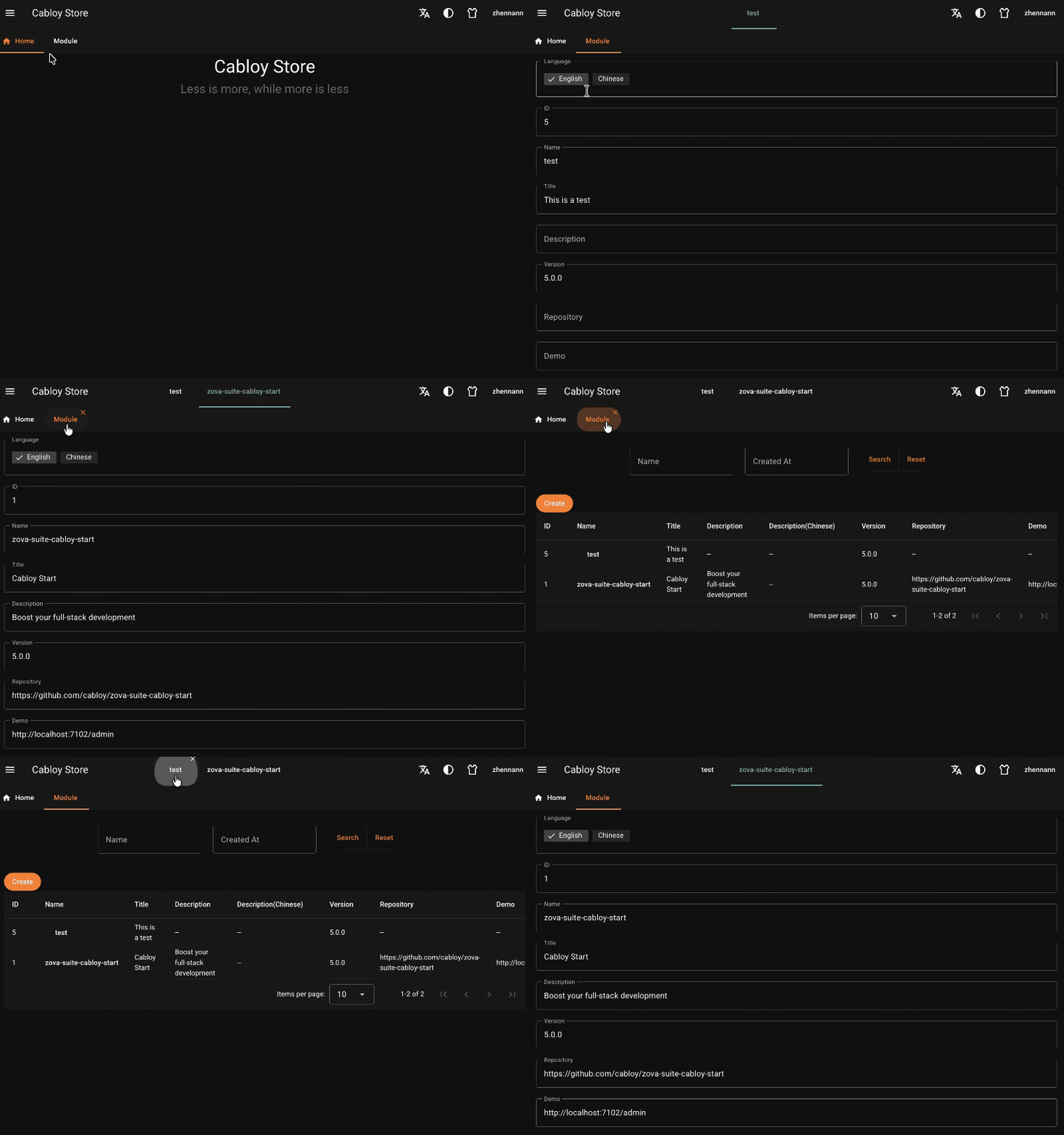
- Supports dual-layer tabs navigation, enabling efficient page switching while maintaining page state
- Dynamically render CRUD list pages, entry pages, and search forms, while demonstrating best practices for Tanstack Table, Tanstack Form, and Tanstack Query
- Dynamically infer and generate DTOs to eliminate redundant type definitions and boost development productivity
Fullstack Mechanism
Vona adopts a frontend-backend separation architecture. The frontend uses the Zova framework, and the built JS bundle is placed into the Vona backend for direct SSR rendering on the backend.
Frontend-backend type sharing mechanism:
- The backend generates Swagger/OpenAPI Schema for generating API SDK on the frontend
- The frontend generates types for icons, routes, and components for providing type hints on the backend
Demo Online
The Website and Admin of Cabloy Store are built by one codebase.
- Website: https://cabloy.com
- Admin: https://cabloy.com/admin
GIF Demo
- Dual-layer tabs navigation
Features
Fullstack: BuildingSSR/SPA/Website/Adminin one codebaseAdmin Supports SSR: Provides full SSR support for Admin applications, preventing sidebar flickering on page refreshCRUD Dynamic Rendering: Dynamically render CRUD list pages, entry pages, and search forms, while demonstrating best practices for Tanstack Table, Tanstack Form, and Tanstack QueryDTO Infer and Generation: Dynamically infer and generate DTOs to eliminate redundant type definitions and boost development productivityDual-layer Tabs Navigation: Supports dual-layer tabs navigation, enabling efficient page switching while maintaining page stateDeveloped in TypeScript: Provides comprehensive TypeScript type hintsUsing ESM modules throughout: Faster project startupFile-level precise HMR: Makes the development experience smoother and more efficientComplete modular system: Module-based business segmentation makes code more cohesive and easier to reuse and shareIOC container and dependency lookup: We recommend usingdependency lookupto obtain bean instances directly from the container, making code writing more intuitive and elegantUniversal bean configuration capabilities: All options of bean classes can be modified in App Config, significantly improving the scalability of the entire system and saving a large amount of configuration-related codeBean global singleton:Async Local Storageis used under the hood to implement a complete global singleton mechanism, ensuring very low memory usage and significantly improving garbage collection performanceMulti-tenancy: Supports the development of multi-tenancy SaaS systems with a shared database schema, but data generated during operation is isolatedMulti-database and multi-datasource: Supports multi-database and multi-datasource, and provides out-of-the-box read-write splitting and dynamic datasource capabilitiesDatabase Transaction: Built-in database transaction capabilities and support for transaction propagation mechanismsCli Commands: Provides a large number of Cli commands for generating code skeletons for various resourcesMenu Commands: Execute Cli commands through the menus, significantly reducing mental overhead and improving the development experienceConfiguration Capabilities Based on Multi-Dimensional Variables: Loads env/config files based on multi-dimensional variables, providing a more flexible configuration mechanism and supporting more complex business scenariosMore Comprehensive AOP Programming: Provides more comprehensive AOP programming capabilities, including controller aspect, internal aspect, and external aspectPlayground: Provides a Playground, which allows us to test the code and verify the ideas very conveniently and quickly
Technology Stack
General
| Name | Version |
|---|---|
| pnpm | >=10.19.0 |
| Nodejs | >=24.8.0 |
| Typescript | >=5.9.3 |
Backend(Vona)
| Name | Version |
|---|---|
| Koa | >=3.0.0 |
| Knex | >=3.1.0 |
| Zod | >=4.1.13 |
| Redis | >=7.2.6 |
| Sqlite3 | builtin |
| MySQL | >=8 |
| Postgresql | >=16 |
Redis: VonaJS provides the following capabilities based on Redis:Queue, Schedule, Startup, Broadcast, Caching, Two-layer cache, and Redlock
Sqlite3: You need to set up the node-gyp environment in advance to ensure thatbetter_sqlite3.nodecan be compiled properly when installing dependencies
Frontend(Zova)
| Name | Version |
|---|---|
| Vite | >=8.0.0 |
| Vue | >=3.5.6 |
| Vue Router | >=4.4.5 |
| Zod | >=4.1.13 |
| Tanstack Query | >=5.92.5 |
| Tanstack Form | >=1.23.5 |
| Tanstack Table | >=8.21.3 |
UI Libraries
Zova can be used with any UI library and comes with built-in project templates for several UI libraries, making it easy to use out of the box.
| Name | Version |
|---|---|
| Daisyui | >=5.3.2 |
| Tailwindcss | >=4.1.14 |
| Quasar | >=2.18.1 |
| Vuetify | >=4.0.1 |
Philosophy
1. About Coding
Many frameworks showcase design elegance with the simplest cases, while ignoring the coding challenges of real business complexity.
As business grows and changes, project code can quickly degrade and become hard to maintain.
Zova addresses large-scale business complexity with a set of engineering solutions, allowing elegant and intuitive code even in complex systems.
This improves development efficiency and experience, while making subsequent iteration and maintenance easier.
2. About Performance
Many frameworks showcase high performance with simplified use cases, neglecting the challenges posed by real business complexity.
As systems scale, performance often suffers, requiring increasingly complex optimizations that bloat the codebase.
Vona takes a different approach: it integrates caching strategies into its core, providing built-in mechanisms such as two-layer cache, query cache, and entity cache.
This allows you to build large-scale systems elegantly while maintaining performance without extensive custom optimization code.
Stay In Touch
License
MIT License.
Copyright (c) 2016-present, Vona.